
If you searched for a burden definition, the word has several meanings in American law. It can describe an obligation, restriction, or duty placed on someone. In court, it often refers to a party’s responsibility to prove a disputed fact.
Short answer: In U.S. law, a burden is a legal duty, restriction, or proof responsibility. In litigation, the term commonly describes who must prove a disputed fact. The required level of proof depends on the claim, proceeding, and applicable standard.
Key Information
| Question | Plain-English answer |
|---|---|
| General legal meaning | A duty, obligation, restriction, or responsibility |
| Courtroom meaning | Responsibility for proving a disputed point |
| Civil cases | Plaintiffs usually prove essential claim elements |
| Criminal cases | The government must prove the defendant’s guilt |
| Common civil standard | Preponderance of the evidence |
| Criminal guilt standard | Beyond a reasonable doubt |
| Important distinction | Proof responsibility and proof standard are different concepts |
| Can proof duties change? | Yes, particular defenses or issues can place duties on another party |
Key Takeaways
- The ordinary word can mean a difficult duty, responsibility, or restriction.
- In legal writing, context determines the precise meaning.
- “Burden of proof” identifies who must establish a disputed point.
- A standard of proof describes how convincing the evidence must be.
- Civil and criminal proceedings usually apply different proof standards.
- Some legal issues can place separate proof responsibilities on defendants.
What Does Burden Mean in Plain English?
Outside court, the word commonly describes something difficult to carry or manage. That difficulty may involve money, responsibility, work, or another obligation. Dictionaries also use the term for physical loads and demanding duties. Legal usage is narrower and depends heavily on context. A statute might impose an obligation on a business or property owner. A court opinion might instead discuss a party’s responsibility for proving facts. Property law provides another useful example. Covenants, easements, and restrictions can limit how land is used. Cornell’s Legal Information Institute describes such restrictions as intangible legal burdens on property.
Burden Definition in U.S. Law
A legal burden definition usually centers on a duty, responsibility, restriction, or procedural requirement. Which meaning applies depends on the sentence and legal subject. Court cases most commonly use the term while discussing proof responsibilities. The U.S. Courts glossary defines “burden of proof” as the duty to prove disputed facts. It notes that plaintiffs generally carry this responsibility in civil cases. The government carries the responsibility for proving guilt in criminal prosecutions. That concept does not tell you how persuasive the evidence must become. The required level is a separate question called the standard of proof. Courts may apply different standards depending on the proceeding and issue.
Proof Responsibility Versus the Standard of Proof
These concepts are related, but they answer different questions. Proof responsibility asks which party must establish a fact. The standard asks how convincingly that party must establish it.
| Concept | Question it answers | Example |
|---|---|---|
| Proof responsibility | Who must prove the point? | A civil plaintiff usually proves claim elements |
| Preponderance standard | How convincing must civil proof be? | More likely true than not |
| Clear and convincing standard | How strong must selected civil proof be? | Higher than ordinary civil proof |
| Reasonable-doubt standard | How strong must proof of criminal guilt be? | The highest familiar trial standard |
This distinction prevents a common misunderstanding. Saying that a plaintiff has the proof responsibility does not identify the required standard. You must examine the governing claim, defense, statute, and jurisdiction.
For most ordinary civil claims, the familiar standard is preponderance of the evidence. LawFlowa explains this test in its preponderance-of-evidence guide. The evidence generally must make the disputed proposition more likely true than not.
Two Parts of the Proof Responsibility
Legal authorities often separate proof responsibility into production and persuasion. The production requirement concerns presenting enough evidence to keep an issue properly before the court. Persuasion concerns convincing the fact finder to the required degree. The two responsibilities can matter at different stages. A party may first need enough evidence to avoid losing before factual evaluation occurs. That party may later need stronger evidence to persuade the judge or jury.
This difference also explains why evidence rules matter. Producing information does not automatically mean the information proves the disputed fact. Courts consider admissibility, credibility, relevance, and persuasive value when applicable.
Who Must Prove a Civil Case?
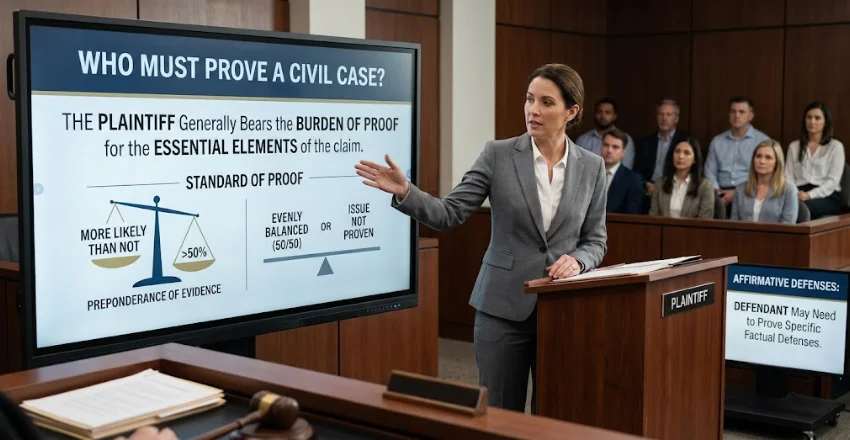
A plaintiff generally must prove the essential elements supporting a civil claim. The exact elements depend on the legal cause of action. Different claims require different factual showings. Most civil claims use a more-likely-than-not standard. If the evidence remains evenly balanced, the party responsible for proof usually loses that disputed issue. LawFlowa’s civil-evidence guide explains why a true 50/50 result is insufficient.
A defendant may still have separate responsibilities regarding certain defenses. For example, an affirmative defense can create a distinct issue requiring supporting evidence. The governing law determines who must establish each disputed proposition.
Who Must Prove Guilt in a Criminal Case?
In a criminal trial, the government must prove the defendant’s guilt. A defendant does not have to prove innocence simply because charges were filed. Federal court guidance states this rule directly.
The prosecution faces a higher standard than plaintiffs usually face in civil cases. Criminal guilt must be established beyond a reasonable doubt. That difference reflects the serious consequences attached to a criminal conviction.
The rule also explains an important feature of criminal pleas. A defendant who proceeds to trial can require prosecutors to satisfy that standard. LawFlowa’s no-contest plea guide explains how plea decisions can affect trial rights.
Can Proof Responsibilities Shift During a Case?
People often hear lawyers say that proof responsibility “shifts.” That phrase can describe several different procedural situations. It does not mean every responsibility automatically changes sides. A party may produce enough evidence to require an opponent to respond. A defendant may also raise a defense carrying its own factual requirements. The exact effect depends on the applicable substantive and procedural law.
Admissions can change what facts require proof altogether. Federal Rule of Civil Procedure 36 allows parties to request admissions concerning specified matters. LawFlowa’s Rule 36 explanation describes how admitted matters can become conclusively established.
A Simple Civil Example
Suppose a customer claims a contractor damaged hardwood flooring. The customer provides dated photographs, invoices, and a witness. The contractor denies responsibility but offers no dated records. A civil fact finder compares the evidence supporting both explanations. The customer does not need to eliminate every imaginable alternative. The customer generally needs the required facts to be more likely true than not. Now assume both explanations appear equally convincing. The customer has not established the disputed point under that standard. A tie does not satisfy the party responsible for proving the claim.
A Simple Criminal Example
Suppose prosecutors charge someone with theft. The government presents witnesses, video, records, and other admissible evidence. Jurors must decide whether prosecutors proved every required element. The accused does not begin trial with a duty to establish innocence. Prosecutors retain the responsibility for proving criminal guilt. The required degree is beyond a reasonable doubt. This rule differs sharply from the ordinary civil standard. A person can therefore face related civil and criminal proceedings with different proof requirements. The governing claim or charge controls the analysis.
Why the Meaning Matters
Understanding the term helps you read court documents more accurately. A judge may discuss pleading duties, evidentiary duties, persuasion, or legal restrictions. Those concepts are not interchangeable. Before evaluating evidence, identify the exact proposition that must be established. Next, determine which party must establish it. Then identify the required standard under the governing law. This sequence can prevent costly misunderstandings about a lawsuit. It can also clarify why strong evidence matters more than sheer volume. Specific legal advice should come from a licensed attorney in the relevant jurisdiction.
The Practical Takeaway
Legal documents use this term in several ways. Always identify the specific duty, restriction, or disputed fact involved. Context determines what the word requires in a particular case. For active litigation, review the controlling law before relying on a general definition. State and federal rules can differ by issue. A qualified attorney can explain the requirements affecting a specific dispute.
Frequently Asked Questions
What is the burden definition in simple terms?
A burden definition in law usually means a duty, obligation, restriction, or responsibility. In lawsuits, it often concerns responsibility for proving a disputed point. The exact meaning depends on the legal context.
What does burden of proof mean?
It means responsibility for proving disputed facts or propositions in a legal proceeding. Civil plaintiffs generally prove the essential elements supporting their claims. Prosecutors must prove criminal guilt.
Is burden of proof the same as standard of proof?
No, the two concepts answer different questions. One determines who must establish the point. The other determines how persuasive the proof must be.
What is the usual standard in a civil lawsuit?
Most ordinary civil claims use preponderance of the evidence. The disputed proposition generally must be more likely true than not. Different claims or issues can require another standard.
What standard applies to criminal guilt?
The prosecution must establish criminal guilt beyond a reasonable doubt. Federal court guidance describes this as a heavier requirement than ordinary civil proof. Defendants do not generally have to prove their innocence.
Does the defendant ever have to prove something?
Yes, particular defenses or factual issues can place separate responsibilities on defendants. The result depends on the defense and governing law. You should check the applicable statute, rules, and controlling decisions.