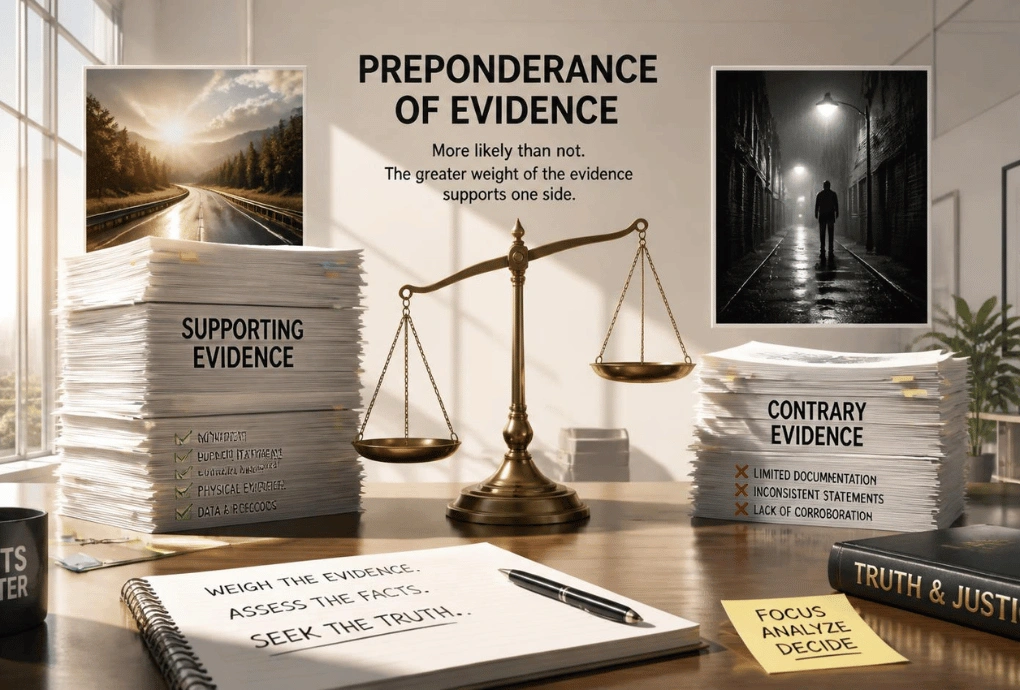
In most U.S. civil cases, the party making a claim does not have to prove it beyond a reasonable doubt. The usual question is simpler: Is the claim more likely to be true than not? Preponderance of evidence: That standard determines whether the party carrying the burden has proved the disputed fact. You might also like Burden Definition in U.S. Law.
Short answer: Preponderance of the evidence is the standard of proof used in most U.S. civil cases. The party with the burden must persuade the fact finder that its position is more likely to be true than not. If the evidence is evenly balanced, that party has not met the standard and loses on that disputed issue.
| Key question | What to know |
| Basic meaning | The disputed fact must be more likely to be true than not. |
| Common shorthand | Greater than 50%, sometimes described as a 51% threshold. |
| Used mainly in | Most civil lawsuits |
| Who usually has the burden? | The plaintiff, on the elements of a civil claim |
| What if the evidence is 50/50? | The party carrying the burden has not proved the issue. |
| Who decides? | The judge or jury acting as the fact finder |
| Higher civil standard | Clear and convincing evidence |
| Criminal guilt standard | Beyond a reasonable doubt |
What the Standard Really Means
Think of the standard as a scale that needs to tip, even slightly, toward one side. The evidence does not need to remove every doubt. It needs to make the proposition that must be proved more probable than its opposite.
Cornell Law School’s Legal Information Institute describes the threshold as a greater-than-50% chance that the claim is true. The Ninth Circuit’s current civil jury instruction uses less mathematical language. The Ninth Circuit model civil jury instruction 1.6 asks instead whether the claim or affirmative defense is more probably true than not true.
That makes the familiar 51% rule a useful shorthand, not an exercise in counting pieces of evidence. Ten weak statements do not automatically outweigh one reliable document. The fact finder considers the evidence as a whole and decides which version is more persuasive. The Ninth Circuit expressly instructs jurors to consider all evidence, regardless of which party presented it.
A tie is not enough. In a 2023 New York small-claims decision, the court described two possible causes as equally likely. Because that created a 50/50 situation, the claimant failed to carry the civil burden.
How Preponderance of Evidence Works in a Civil Case
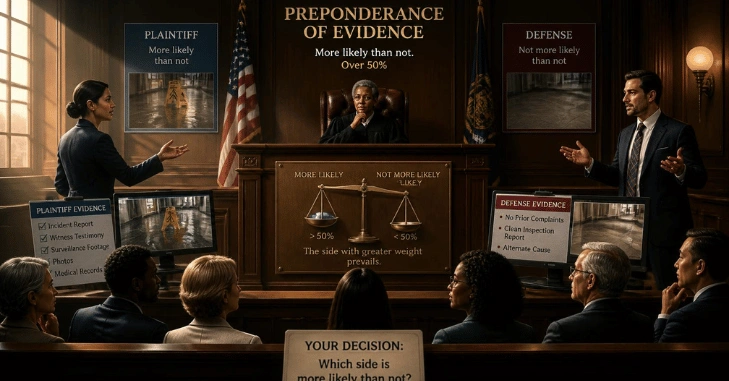
The plaintiff generally bears the burden of proving the elements required for a civil claim. Cornell explains that the broader burden of proof includes two related concepts: the burden of production and the burden of persuasion.
The burden of production concerns whether a party has presented sufficient evidence to put an issue before the court properly. The burden of persuasion asks whether the evidence ultimately convinces the judge or jury to the required degree.
Preponderance of evidence. Those burdens do not always rest on one side for every issue. A defendant who raises an affirmative defense may have to prove that defense. Current Ninth Circuit instructions expressly recognize that the civil standard may apply to either a claim or an affirmative defense.
This is why identifying the burden matters before comparing the evidence. You first need to know which party must prove which fact and what legal standard governs it.
Readers dealing with a broader civil dispute can also review LawFlowa’s guide to how civil lawyers handle disputes and evidence.
A Simple Example of How the Scale Tips
Suppose a customer claims that a contractor damaged a floor during renovation work. The contractor denies causing the damage. The customer presents dated photographs showing an undamaged floor before the work. A neighbor testifies that the damage appeared during construction. An invoice also shows that heavy equipment was moved through the affected room.
The contractor testifies that the floor might have been damaged earlier but provides no dated photographs or other supporting records. A civil fact finder does not need absolute certainty about what happened. The issue is whether the customer’s account is more persuasive and more likely to be correct. If it is, the burden can be satisfied even though another explanation remains possible.
If both explanations appear equally probable, the customer loses on that issue because the burdened side has not tipped the scale beyond 50/50.
Where This Civil Proof Standard Is Commonly Used
Most ordinary civil claims use the more-likely-than-not test. Personal injury matters, contract disputes, business disputes, and other civil actions are common examples.
Negligence cases often turn on several facts, such as duty, breach, causation, and damages. Medical cases may rely heavily on records and expert testimony. LawFlowa’s explanation of medical liability claims and evidence of negligence provides relevant context.
Product cases can involve proof of defects, inadequate warnings, causation, and injuries. Readers researching that area can also see LawFlowa’s overview of product liability claims, along with supporting evidence.
The precise burden can change depending on the claim, defense, proceeding, or jurisdiction. A court may require a higher standard for a particular issue, so the governing statute and jury instructions matter.
How the Three Main Standards of Proof Compare
The three familiar standards should not be treated as interchangeable. They reflect different levels of confidence required before a legal fact is established.
| Standard | Plain-English test | Typical setting |
| Preponderance | More likely to be true than not | Most civil claims |
| Clear and convincing evidence | Evidence creates a firm belief or conviction that the claim is highly probable. | Selected civil claims or issues |
| Beyond a reasonable doubt | Highest burden of proof | Criminal guilt |
The Ninth Circuit defines clear and convincing evidence as proof that leaves the fact finder with a firm belief or conviction that the factual contention is highly probable. It expressly places that standard above the ordinary civil burden but below proof beyond a reasonable doubt.
Criminal guilt uses the much higher reasonable-doubt standard. Cornell likewise distinguishes that criminal requirement from the lower burden generally used in civil litigation.
The difference matters because the consequences are different. A person researching a civil damages claim should not assume that the burden of proof used by the prosecution in a criminal trial also governs a civil lawsuit.
What Kind of Evidence Can Tip the Scale?
There is no fixed number of witnesses, documents, photographs, or expert opinions needed to satisfy a civil burden. The central question is how convincing the complete record is.
Depending on the dispute, persuasive proof may include contracts, emails, photographs, medical records, financial records, eyewitness testimony, expert opinions, admissions, inspection reports, or other admissible evidence.
Credibility matters, too. A detailed record created at the time of an event may carry more weight than a vague recollection years later. Likewise, evidence that consistently fits with other facts may persuade a fact finder more than a larger body of conflicting evidence.
The practical lesson is simple: More evidence is not automatically better evidence. What matters is whether the admissible proof makes the required fact more probable than not.
Why Knowing Who the Burden Matters
The burden determines what happens when uncertainty remains. Imagine that a jury considers both sides equally believable. If the plaintiff must prove a particular element and the evidence ends in a tie, the plaintiff does not receive the benefit of that uncertainty. The element remains unproved.
The same logic can apply to a defendant carrying the burden on an affirmative defense. The Ninth Circuit’s model instruction covers claims and affirmative defenses using the same formulation: whoever carries the burden must make the proposition more probably true than not true. That is why lawyers often organize a case element by element rather than asking only which side has more evidence.
The Practical Takeaway
For most U.S. civil disputes, winning a factual issue does not require eliminating every possible alternative. The burdened party must make its version more persuasive than the competing version.
Preponderance of evidence: Start by identifying the elements of the claim, determining who carries the burden on each one, and finding the exact instruction that applies in the relevant jurisdiction. Then organize the strongest admissible evidence around those elements rather than focusing solely on volume.
If an active lawsuit, deadline, or significant legal right is involved, review the governing state or federal law and speak with a licensed attorney in the appropriate jurisdiction. This article provides general legal information, not advice for a specific case.
Frequently Asked Questions
It means the side bearing the burden must show that the disputed fact is more likely than not to be true. The scale must tip in that party’s favor, even if only slightly.
“51%” is a common way to explain a greater-than-50% threshold. Jury instructions may instead use phrases such as “more probably true than not true.” Courts generally ask fact finders to evaluate persuasiveness rather than assign exact numerical probabilities to individual exhibits.
The party carrying the burden loses on that issue. A true 50/50 balance does not establish that one version is more likely than the other.
Not to establish criminal guilt. The prosecution must prove guilt beyond a reasonable doubt. Different standards may apply to other questions or defenses, depending on the governing law.
No. Clear and convincing evidence is a higher burden. It requires a firm belief or conviction that the relevant factual contentions are highly probable while still falling below the criminal reasonable-doubt standard.