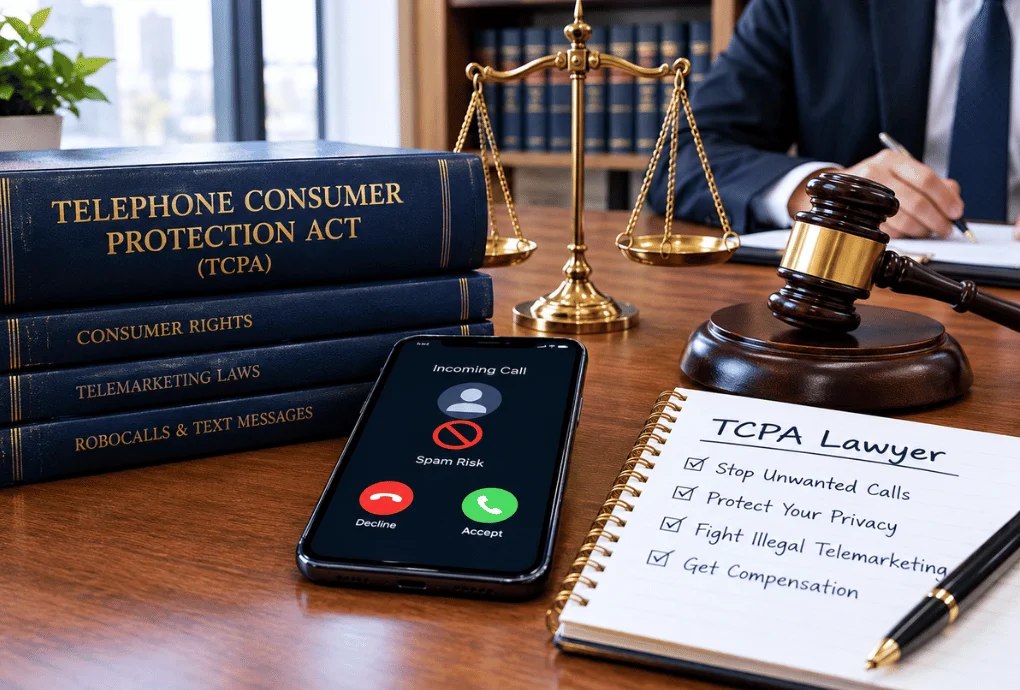
Repeated robocalls and unwanted marketing texts can be more than an everyday annoyance. Federal law restricts certain automated calls, prerecorded messages, telemarketing calls, and text messages. A Telephone Consumer Protection Act lawyer can examine the communications, consent history, and available evidence to determine whether you may have a claim.
The Telephone Consumer Protection Act, commonly called the TCPA, also creates private remedies for qualifying violations. Depending on the provision involved, statutory damages can reach $500 per violation, with possible increases for willful or knowing violations.
Direct answer: A TCP A lawyer reviews unwanted calls or texts to determine whether federal telemarketing rules were violated. The review may examine consent, prerecorded voices, dialing technology, opt-out requests, and Do Not Call protections. When a violation supports a private claim, the lawyer can assess damages and available legal options.
| TCPA issue | What you should know |
|---|---|
| Unwanted robocalls | Certain automated or prerecorded calls are restricted. |
| Marketing texts | Text messages can fall within TCPA protections. |
| Prior consent | Consent can significantly affect whether a communication violates the law. |
| Revoking consent | Federal rules recognize reasonable methods of revocation. |
| Do Not Call rules | Separate protections can apply to qualifying telemarketing calls. |
| Potential damages | Certain violations allow $500 in statutory damages. |
| Willful violations | Courts may increase some awards up to three times the statutory amount |
| Useful evidence | Call logs, texts, voicemails, screenshots, and opt-out records |
What Does the Telephone Consumer Protection Act Protect?
Congress enacted the TCPA to regulate specified telephone practices, including automatic dialing systems and artificial or prerecorded voice messages. The statute also establishes rules concerning telephone solicitations and unsolicited advertisements. The exact requirements depend on the communication and circumstances.
Text messages can also fall within TCPA protections. The Supreme Court has previously recognized a text to a cellular telephone as a “call” for purposes of a key TCPA provision. More recently, a federal district court concluded that texts also qualify under the statute’s National Do Not Call provisions, although courts have addressed aspects of this issue differently.
The law does not make every unwanted phone call illegal. Consent, the reason for the communication, the technology involved, exemptions, and other facts can change the analysis. This fact-specific nature is one reason preserving the original communications can be important.
When Should You Contact a Telephone Consumer Protection Act Lawyer?
Consider getting a legal review when unwanted communications form a repeated pattern rather than assuming every annoying call creates a lawsuit. A Chapter 7 Lawyer can compare your records against the statute, FCC rules, and relevant court decisions. That assessment can help separate potentially actionable communications from calls that are lawful or exempt.
Possible warning signs include:
- Repeated prerecorded or artificial-voice calls.
- Marketing texts you did not expect to receive.
- Calls or texts continuing after an opt-out request.
- Repeated solicitations despite a company-specific do-not-call request.
- Qualifying sales calls after your personal number entered the National Do Not Call Registry.
- Messages apparently intended for someone else that continue after notice.
- Automated communications where you dispute giving the required consent.
None of these circumstances automatically proves liability. The TCPA contains several provisions with different requirements, and defenses may apply. An attorney must examine the facts before determining whether a viable claim exists.
How Much Can a TCPA Claim Be Worth?
The TCPA provides statutory remedies for certain private claims. Under 47 U.S.C. § 227(b)(3), a successful claimant may seek actual monetary loss or $500 for each violation, whichever is greater. A court may increase an award to as much as three times that amount when it finds a willful or knowing violation.
That means the frequently advertised “$500 to $1,500 per call or text” range requires context. The higher figure is not automatic, and different TCPA provisions have different elements. A lawyer must first determine which communications qualify and whether enhanced damages have legal support.
Potential value also should not be calculated by multiplying every unwanted communication by $1,500. Some communications may fall outside the statute, have valid consent, or involve an exemption. The circumstances surrounding each call or message can affect a damages analysis.
Consent Is Often Central to a TCPA Case
Consent is one of the first issues likely to arise during a case review. A company may argue that you supplied your telephone number, checked an authorization box, signed an agreement, or otherwise permitted communications. The relevant form of consent depends partly on the communication at issue.
Consent disputes can become complicated when telephone numbers pass through lead-generation websites or marketing partners. A record showing that you entered a number somewhere does not by itself answer every legal question. The wording and scope of the authorization can matter.
Keep copies of forms, emails, account pages, and other records showing how the business obtained your number. These materials can help establish what you agreed to receive. They can also help an attorney evaluate whether the later communications stayed within that permission.
Can You Revoke Permission for Robocalls or Robotexts?
FCC rules recognize that consumers can revoke consent to covered robocalls and robotexts through reasonable means. The FCC has identified methods such as responding with “STOP” or using an opt-out mechanism supplied by the caller. Applicable revocation requests generally must be honored within a reasonable period, subject to the governing rules.
The details remain important because federal consent rules have undergone recent regulatory changes and implementation adjustments. In 2025, for example, the FCC delayed part of a rule concerning whether revocation for one type of communication must extend to unrelated communications from the same caller. Consumers should therefore avoid relying on simplified statements that every opt-out automatically ends every possible communication.
If you revoke consent, create evidence of the request. Save your outgoing text, email, screenshot, or other record showing what you communicated and when. A written cease and desist letter can also document your demand. Keep later calls and texts instead of immediately deleting them.
Does the National Do Not Call Registry Matter?
The National Do Not Call Registry gives consumers a way to limit many telemarketing sales calls. The FTC explains that sellers and telemarketers covered by its rules must update calling lists against the Registry at least every 31 days. Several categories of communications are treated differently or excluded from the Registry’s protections.
For example, the Registry primarily concerns personal telephone numbers rather than business lines. Certain charitable, political, and other communications can also be treated differently under applicable rules. Registering a number therefore does not mean every later call violates federal law.
TCPA provisions can create private remedies for certain violations of telephone-solicitation regulations. Section 227(c), for example, addresses circumstances involving more than one call within 12 months by or on behalf of the same entity. The statutory requirements should be evaluated before estimating damages.
What Evidence Should You Save Before Talking to a Lawyer?
Good records can make a potential claim easier to evaluate. Do not depend on memory when your phone already contains dates, timestamps, messages, and telephone numbers. Preserve the evidence before blocking a number or changing devices.
Useful records can include:
- Screenshots showing complete text-message conversations.
- Call logs showing dates, times, and telephone numbers.
- Voicemails and prerecorded messages.
- Screenshots of caller ID information.
- Copies of messages where you wrote “STOP” or otherwise opted out.
- Opt-out confirmation messages.
- Evidence showing when you joined the National Do Not Call Registry.
- Contracts or forms that may contain consent language.
- Notes identifying the company, product, or service promoted.
- Records of communications received after consent was revoked.
Avoid editing screenshots in ways that remove timestamps or sender details. Keeping the original messages on your device may preserve context that a cropped image cannot show. Backups can also help if you later replace or lose the phone.
How a TCPA Lawyer Evaluates Unwanted Calls and Texts
A lawyer typically starts by identifying who initiated or benefited from the communications. Caller ID alone may not provide the complete answer, especially when marketers, lead generators, contractors, or outside calling companies are involved. Identifying the responsible entity can therefore require investigation.
The attorney can then examine the type of communication and the legal provision involved. A prerecorded sales call raises different questions from a live telemarketing call to a registered number. An automated text may present still other issues involving consent and technology.
The lawyer can also review your consent and opt-out history. That review may include forms you completed, prior dealings with the company, and the language used when you asked communications to stop. These facts help determine whether pursuing a private claim is legally supportable.
Autodialers After Facebook v. Duguid
Consumers sometimes assume that any computer-generated communication automatically involves an “automatic telephone dialing system.” That assumption is too broad after the Supreme Court’s 2021 decision in Facebook, Inc. v. Duguid. The Court interpreted the TCPA’s statutory definition more narrowly than some earlier courts had done.
The Court held that qualifying equipment must have the capacity to store or produce telephone numbers using a random or sequential number generator. The decision means that automation alone does not necessarily establish that equipment meets the statutory ATDS definition.
This ruling did not eliminate TCPA protections against unwanted communications. Prerecorded or artificial-voice provisions and separate telemarketing rules can remain relevant. A case should therefore be evaluated under the provisions that match the actual communications rather than relying only on whether a system seemed automated.
What Should You Do After Receiving Suspected TCPA Calls or Texts?
Start by preserving the evidence rather than arguing extensively with the caller. Save messages and call records, then document any clear request that communications stop. Consistent records make the sequence of events easier to reconstruct.
You can also register a personal number with the National Do Not Call Registry when appropriate. If unwanted telemarketing continues, FTC guidance provides a process for reporting calls. The Registry does not stop scammers automatically, but registration and complaint records can document the problem.
Consumers may also submit complaints concerning unwanted calls and texts to the FCC. The FCC explains that it generally does not resolve individual unwanted-call or text complaints. Instead, those reports can support enforcement and policy work.
Why Legal Review Can Matter
TCPA cases can turn on details that are difficult to evaluate from a call log alone. The identity of the caller, purpose of the message, type of technology, consent language, and opt-out history can all matter. State consumer-protection or telemarketing laws may also provide separate rules depending on where the communications occurred.
Legal review can also prevent unrealistic expectations about compensation. Statutory damages do not mean every unwanted call automatically produces a $500 or $1,500 recovery. A claimant still must establish the requirements of the provision being asserted.
For that reason, preserve the complete record and obtain advice based on your specific circumstances. A telephone consumer protection act lawyer can assess the evidence, identify potentially applicable claims, and explain the options available under current law. More from us: Bridge Collapse Lawyer.
Frequently Asked Questions About TCPA Lawyers
Can I sue a company for unwanted robocalls?
Potentially, but receiving an unwanted call alone does not establish a TCPA violation. The statute creates private causes of action for qualifying violations and provides statutory remedies in specified circumstances. Whether you can sue depends on facts such as the communication type, consent, calling method, and applicable provision.
A legal review can determine whether the evidence supports a claim. Keep the calls, voicemails, and related records while that determination is made. Deleting everything can make later investigation harder.
Can unwanted text messages violate the TCPA?
Yes, text messages can fall within TCPA protections. The Supreme Court has recognized texts as calls under Section 227(b), although the specific legal requirements still depend on the claim being asserted.
Not every commercial text is unlawful. Consent, message content, technology, and applicable exceptions can affect the result. The safest approach is to preserve the entire message thread for review.
Can I receive $1,500 for every unwanted call?
Not automatically. Federal law provides $500 statutory damages for certain violations and allows courts to increase qualifying awards for willful or knowing violations. The statute permits an increase up to three times the otherwise available amount in specified circumstances.
A court must have a legal basis for enhanced damages. The number of actionable violations also requires analysis. Treat advertisements promising a guaranteed amount for every unwanted call with caution.
What if calls continued after I said stop?
Communications continuing after a valid revocation request can deserve closer review. FCC rules recognize reasonable ways for consumers to revoke consent to covered robocalls and robotexts, including standard opt-out methods.
Save evidence showing exactly when and how you asked the company to stop. Also preserve everything received afterward. That timeline may become important when an attorney assesses the communications.
Do I need a telephone consumer protection act lawyer to file an FCC complaint?
You do not need an attorney simply to submit an informal unwanted-call or text complaint to the FCC. The agency provides a consumer complaint process directly to the public. It also explains that TCPA-related unwanted-call complaints generally inform enforcement rather than resolve individual claims.
A private lawsuit is a different matter from filing a regulatory complaint. Legal advice can be useful if you want to understand potential damages, defenses, deadlines, or litigation options. Those questions depend on the facts and governing law.
Take the Next Step After Repeated Unwanted Calls or Texts
Repeated marketing calls and messages deserve a careful review when they continue despite opt-outs or appear to violate federal calling rules. Preserve your call logs, screenshots, voicemails, consent records, and opt-out evidence. Those records provide a stronger factual starting point than estimates based on memory.
If you believe your TCPA rights may have been violated, consider having the communications reviewed by qualified consumer counsel. A case-specific assessment can identify which federal or state protections apply and whether pursuing a claim makes sense.