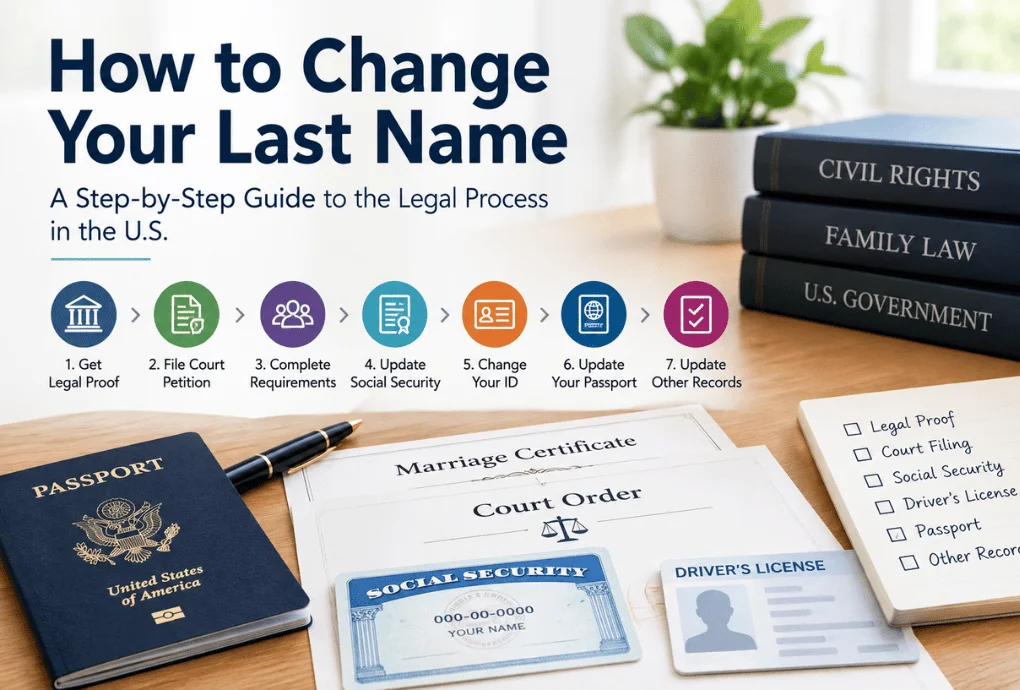
Changing your last name in the United States usually starts with a marriage certificate, divorce decree, or court order. After establishing the legal change, update your Social Security record and state-issued identification. Then update your passport, financial accounts, employer records, insurance, and other important documents.
The exact process depends on why you are changing your name and where you live. State court requirements, filing fees, hearings, and publication rules can differ. This guide explains the typical U.S. process and the documents you may need.
Direct answer: To legally change your last name, first obtain proof through marriage, divorce, or a court order. Next, update your Social Security record and state identification. Then change your passport and remaining financial, employment, tax, insurance, property, and personal records.
Last Name Change at a Glance
| Situation | Usual Legal Proof | Court Petition Usually Needed? | Next Major Step |
|---|---|---|---|
| Marriage | Certified marriage document | Usually no | Update Social Security |
| Divorce | Divorce decree authorizing the change | Usually no | Update Social Security |
| Personal choice | Court order | Usually yes | Update Social Security |
| Adoption | Adoption order or related court document | Often handled within adoption | Update identity records. |
| Other circumstances | Depends on state law | Often yes. | Follow state court requirements. |
The table provides a general U.S. overview rather than rules for every jurisdiction. Your state or county may require different documents. Check the appropriate court or government agency before filing anything.
What You’ll Need Before Changing Your Last Name
Gather your important records before starting the process. Having the correct documents can prevent repeated visits to courts and government offices. Keep original or certified documents available when an agency requires them.
Common documents may include:
- Current driver’s license or state identification
- Birth certificate
- Social Security card or Social Security number
- Certified marriage certificate
- Certified divorce decree
- Certified court order approving the name change
- Current U.S. passport
- Proof of residence when required
- Additional documents required by your state or county
A marriage certificate, divorce decree, or court order commonly establishes the legal basis for the change. The document you need depends on your circumstances. Agencies can also impose their own documentation requirements.
How to Change Your Last Name in 7 Steps
The process becomes easier when you handle records in a practical order. Start by securing legal proof of your new name. Then use that proof to update the records that other organizations commonly rely upon.
1. Determine the Legal Basis for Your Name Change
First, identify why your surname is changing. Marriage and divorce often provide legal documents that can support the change. Other voluntary changes commonly require a court proceeding.
A marriage certificate may provide the documentation needed for a marriage-related change. A divorce decree can sometimes authorize restoration of a former surname. Check the decree carefully to confirm what it permits.
If neither situation applies, you will generally need to follow your state’s court process. Requirements vary significantly between jurisdictions. Your local court can provide the forms and filing instructions used where you live.
2. File a Name Change Petition When a Court Order Is Required
A court-ordered change usually begins by filing a petition in the appropriate state or local court. The petition generally identifies your current name and requests a new name. It may also ask why you want the change.
Some jurisdictions impose additional requirements before a judge approves the petition. These can include notice, publication, background checks, fingerprints, or a hearing. Requirements and available privacy protections depend on state law.
Pay close attention to local instructions rather than relying on another state’s procedure. Court filing fees also vary by jurisdiction. Ask about a fee waiver if paying the filing cost would create financial hardship.
3. Complete Any Notice, Publication, or Hearing Requirements
Your court may require additional steps after you file. Some jurisdictions require public notice before a requested name change becomes final. Others provide exceptions or use different procedures.
A hearing may also be required. If so, bring every document listed in your court instructions. Missing paperwork can delay a decision or require another appearance.
Privacy concerns deserve special attention before publication. Some states provide confidentiality protections in qualifying circumstances, including certain safety situations. Ask the court about available procedures before publishing personal information.
4. Obtain Certified Proof of Your Legal Name
Once the legal process is complete, obtain the document proving your new name. This might be your marriage certificate, divorce decree, or signed court order. Government agencies commonly request official evidence before changing their records.
Consider obtaining multiple certified copies when appropriate. Several organizations may need to inspect or receive proof during the update process. Keep at least one secure copy for your permanent records.
Do not assume every organization accepts ordinary photocopies. For example, the Social Security Administration has specific evidence requirements. Check each agency’s current rules before mailing original or certified documents.
5. Update Your Social Security Record
Notify the Social Security Administration after your legal name changes. SSA recognizes documents such as marriage records, divorce decrees, naturalization certificates, and court orders as potential evidence. Additional identity documentation may be required depending on your circumstances.
Updating Social Security early helps keep other records consistent. The IRS advises taxpayers to use a name matching their Social Security record. A mismatch can contribute to tax-return processing or refund delays.
Your Social Security number does not change simply because your name changes. Instead, SSA updates the name associated with your existing number. Tell your employer about the change so payroll and wage records can also be corrected.
6. Change Your Driver’s License or State ID
Next, contact your state’s motor vehicle agency. Each state establishes its own forms, documentation rules, fees, and deadlines. Some states may require the Social Security update first.
Bring the legal name-change document and any identification the agency requires. You may also need proof of residence or your existing license. Review your state’s requirements before visiting an office.
Remember to address related motor vehicle records when necessary. Your vehicle title and registration may still display your former name. Keeping these records consistent can reduce confusion later.
7. Update Your Passport and Remaining Records
A U.S. passport requires a separate update through the Department of State. The required passport procedure depends partly on your circumstances and timing. Your legal name-change document may need to accompany the application.
For certain qualifying changes within one year of passport issuance, Form DS-5504 may apply. Other applicants may need a renewal or in-person application process. Always check current State Department instructions before submitting your passport.
After your primary identification is updated, work through your remaining records. Keeping a checklist can prevent overlooked accounts. Save confirmation documents until every important organization recognizes your new name.
Records to Update After a Last Name Change

A legal change does not automatically update every account you use. Each organization maintains its own records. You will usually need to contact several agencies and private companies separately.
Important records may include the following.
- Social Security record.
- Driver’s license or state ID.
- U.S. passport.
- Employer and payroll records.
- Bank and credit union accounts.
- Credit cards.
- Loans and mortgage records.
- Vehicle title and registration.
- Voter registration.
- Insurance policies.
- Medical records.
- Professional licenses.
- School or university records.
- Lease or property records.
- Utilities.
- Retirement and investment accounts.
- Airline and travel accounts.
- Memberships and subscriptions.
Prioritize records tied to your identity, employment, taxes, finances, and travel. Those records can affect later updates with other organizations. Personal memberships and subscriptions can usually come afterward.
Changing Your Last Name After Marriage
Marriage is one of the most common reasons for changing a surname. In many situations, your certified marriage document provides evidence of the change. A separate court petition is often unnecessary for a conventional marriage-related surname change.
The exact options available can depend on state law and the names involved. A more unusual change may require a court order even after marriage. Check local requirements before assuming your marriage document supports your preferred surname.
After receiving the certified marriage document, update Social Security and your state identification. You can then address your passport and private accounts. Keep the spelling and formatting consistent across applications.
Changing Your Last Name After Divorce
A divorce proceeding may allow you to restore a former surname. The final divorce decree should clearly support the requested change when required. Confirm the language before assuming the decree provides sufficient proof.
If your final decree does not authorize the desired change, additional legal steps may be necessary. The process depends on your state’s rules and the wording of the order. Your court clerk can explain available procedural information.
Once you have acceptable legal evidence, update the same major records. Start with Social Security before addressing tax records and many other accounts. Keep certified copies of the decree available during the process.
How Much Does Changing Your Last Name Cost?
There is no single nationwide price for changing a surname. Marriage or divorce-related changes may avoid a separate name-change court filing. Court-ordered changes can involve filing and other locally imposed costs.
Possible expenses include:
- Court filing fees.
- Certified document copies.
- Publication costs where required.
- Fingerprinting or background-check costs where required.
- State identification replacement fees.
- Passport fees when applicable.
- Professional license replacement fees.
Check your court’s current fee schedule before filing. Do not rely on another county’s quoted price. Fee-waiver programs may be available to qualifying applicants.
How Long Does a Legal Name Change Take?
There is no nationwide processing time for a court-ordered surname change. Timing depends on the state, local court schedule, required notices, and your individual case. Missing paperwork can also extend the process.
Marriage-related changes may move faster because the marriage document can provide the required legal evidence. Divorce-related changes may also be simpler when the decree expressly authorizes the requested surname. Updating every account afterward can still take additional time.
Plan around upcoming travel, tax filing, employment verification, and other deadlines. Avoid booking important travel under conflicting names when possible. Your ticket and travel identification should use compatible information.
Common Mistakes to Avoid
Name changes involve several independent organizations, so consistency matters. A small documentation mistake can create delays across multiple accounts. Keeping a written checklist makes the administrative work easier to manage.
Avoid these common problems.
- Filing in the wrong court.
- Using forms from another state.
- Assuming marriage permits every possible surname.
- Overlooking required notice or publication rules.
- Ordering too few certified copies.
- Updating private accounts before securing legal proof.
- Forgetting employer and payroll records.
- Filing taxes under a name that conflicts with Social Security records.
- Booking travel using a name that conflicts with your identification.
- Assuming a court order automatically updates every government record.
Keep copies of applications, receipts, and correspondence whenever possible. Record the date each organization accepted your request. This creates a useful paper trail if an account remains under your former name.
Do You Need a Lawyer to Change Your Last Name?
Many routine name changes can be handled without hiring an attorney. Courts commonly provide forms and procedural instructions for self-represented applicants. Straightforward marriage-related updates may not require a separate court case.
Legal advice may become useful when the situation is complicated. Examples include disputed petitions, unclear divorce orders, criminal-history issues, custody concerns, immigration questions, or serious privacy risks. A family law attorney can explain how your state’s law applies to your circumstances.
Court employees can often provide forms and procedural information. They generally cannot provide personalized legal advice. If you need to find qualified counsel, a lawyer directory can help you locate a local family law attorney. Distinguishing those roles can help you decide what assistance you need.
Frequently Asked Questions
How to change your last name legally in the United States?
Start by determining whether a marriage certificate, divorce decree, or court order will establish your new surname. If a court order is necessary, follow your state and local court procedures. Then update Social Security, state identification, your passport, and remaining records.
The specific forms and requirements depend on your jurisdiction. Federal agencies also maintain separate procedures for their own records. Always check current government instructions before submitting original documents.
Can I change my last name without getting married?
Yes, adults can generally seek a legal name change for reasons unrelated to marriage. You will commonly need to petition the appropriate court. State law determines the filing process and applicable restrictions.
A judge can review the requested change before issuing an order. Courts may reject requests connected to fraud or other unlawful purposes. Local rules determine what supporting steps are required.
Do I need a court order after marriage?
A separate court order is often unnecessary for a standard marriage-related surname change. Your certified marriage document may provide sufficient legal evidence. The exact options still depend on applicable law and the requested name.
Unusual surname combinations or unrelated names can require different procedures. Check your state’s requirements before submitting applications. This prevents inconsistencies across government records.
Should I update Social Security before my driver’s license?
Updating Social Security early is generally a practical approach. USAGov specifically advises notifying SSA early during the process. Your state motor vehicle agency may also have its own sequencing requirements.
Check your state’s rules before visiting the licensing office. Bring every required document with you. This can reduce repeat visits caused by missing evidence.
Does changing my last name change my Social Security number?
A legal name change does not normally give you a new Social Security number. SSA instead updates the name associated with your existing record. You should also tell your employer after the update.
Accurate employment records help ensure wages are associated with the correct Social Security record. They also reduce potential inconsistencies during tax season. Keep confirmation of your update for your records.
What happens if my tax return uses my old name?
The IRS says the name on your tax return should match your Social Security record. A mismatch can cause processing problems or refund delays. Update SSA before filing under the new name.
If SSA still has your former name, review IRS instructions before filing. Do not assume another agency has automatically updated federal tax records. Coordinating the records can prevent avoidable delays.
Can a court deny my requested last name?
Courts can deny name-change petitions in certain circumstances. A requested change generally cannot be used to facilitate fraud or evade legal obligations. Other restrictions vary by state.
The court may also require additional information before deciding your request. Follow every local filing and notice requirement carefully. Seek legal advice if your petition raises unusual issues.
Final Checklist for Your Name Change
Before considering the process finished, compare your major records. Your legal name should be consistent across the documents you regularly use. Address discrepancies before they cause problems with taxes, employment, finances, or travel.
Use this final checklist:
- Obtain legal proof of your new surname.
- Complete court requirements if a petition is necessary.
- Get certified copies of your legal document.
- Update your Social Security record.
- Update your driver’s license or state ID.
- Update your U.S. passport when applicable.
- Notify your employer and update payroll records.
- Update banks, credit cards, loans, and insurance.
- Update vehicle, property, professional, and voter records.
- Review remaining personal accounts for your former name.
Keep your marriage certificate, divorce decree, or court order in a secure place. You may need it again years after completing the initial updates. A permanent record can also help resolve future identity-document questions.
The Bottom Line
Changing a surname is usually a sequence rather than a single filing. First establish the legal change, then update the agencies and organizations that maintain your identity records. Your reason for changing the name determines which legal document starts that process.
Because state procedures differ, use your local court’s current instructions for any judicial name change. Use current federal guidance for Social Security and passport updates. Careful sequencing and consistent records can make the process much easier.