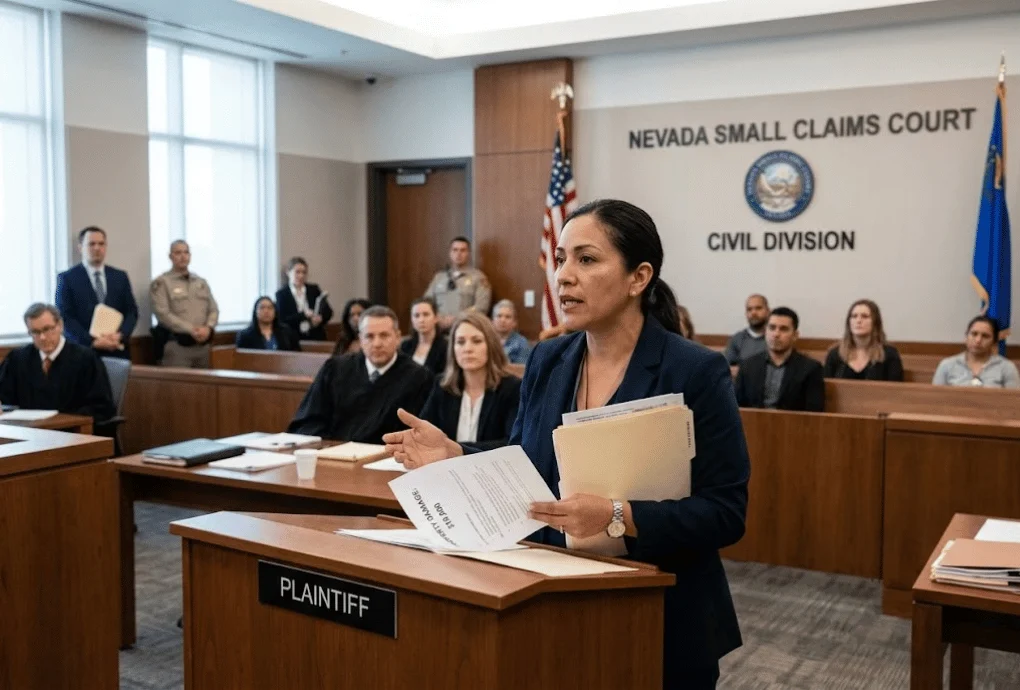
The Nevada small claims court property damage limit is $10,000 for money claims. That ceiling applies whether the dispute involves a damaged car, personal belongings, or other property loss. The right court still depends on the amount claimed, the defendant, and the type of case.
Nevada’s small-claims property-damage ceiling is $10,000. Small claims can award money, but the process cannot award more than that amount. Claims above $10,000 may fit regular Justice Court civil jurisdiction, which reaches $15,000 for covered disputes. Larger claims generally require District Court.
| Key point | Nevada rule |
|---|---|
| Small-claims maximum | $10,000 |
| Regular Justice Court civil limit | Up to $15,000 for covered property-damage cases |
| Type of relief in small claims | Money only |
| Common venue options | Defendant’s township or where the property injury occurred |
| Common deadline for damaged personal property | Three years, subject to the claim and exceptions |
| Small-claims filing fee | State fee schedule ranges from $45 to $175, before possible local additions |
Key takeaways
- Small claims is available for qualifying money claims of $10,000 or less.
- A property-damage claim over $10,000 may fit regular Justice Court instead.
- You generally must file in a township connected to the defendant or the damage.
- Many personal-property damage claims have a three-year filing period.
- Photos, repair records, communications, and proof of payment can strengthen the case.
What the Nevada Small Claims Court Property Damage Limit Covers
Nevada’s small-claims statute, NRS Chapter 73, gives justices of the peace small-claims jurisdiction for money claims not exceeding $10,000. Property damage can qualify when the plaintiff seeks money rather than an order requiring repairs. The statute also recognizes property injury when describing proper venue for filing.
The limit applies to the amount you ask the court to award. A $4,500 repair dispute can fit if the other small-claims requirements are met. A $12,000 loss does not meet the small-claims ceiling unless you reduce the amount sought.
Property disputes can arise from vehicle crashes, contractor work, damaged belongings, or similar events. The legal theory may affect deadlines and proof requirements. The $10,000 ceiling does not decide whether the defendant is legally responsible.
What Happens When Property Damage Exceeds $10,000?
Nevada separates small claims from the broader civil jurisdiction of Justice Court. Regular Justice Court can hear covered property-damage actions up to $15,000. That means a $12,000 claim may belong there instead of small claims.
| Amount sought | Possible Nevada court track | Important point |
|---|---|---|
| $10,000 or less | Small Claims in Justice Court | Simpler money-claim process |
| $10,000.01 to $15,000 | Regular civil case in Justice Court | Small-claims procedures no longer apply |
| More than $15,000 | Usually District Court | Broader civil procedures apply |
Some local Nevada courts allow a plaintiff to waive the excess above $10,000. North Las Vegas Justice Court expressly describes that option and bars splitting one claim into two cases. Giving up part of a claim can have lasting consequences, so review the local rules first.
A larger or disputed case may justify legal advice before choosing a forum. LawFlowa’s civil-lawyer guide explains how lawyers handle evidence, filings, negotiations, and court disputes. The value of professional help depends on the amount at stake and the complexity of the case.
Where Should You File a Nevada Property-Damage Small Claim?
Nevada’s small-claims statute uses township-based venue rules. You can generally file a case where the defendant lives, works, or does business. You may also file property-injury cases in the township where the injury occurred.
This matters because Nevada Justice Courts serve defined townships. Filing in the wrong location can delay the case or create a venue challenge. Check the specific Justice Court’s current forms before paying a filing fee.
The court’s local instructions can also add procedural requirements. North Las Vegas, for example, requires a written payment demand before filing its small-claims case. Other townships may use different forms, deadlines, or service procedures.
How Long Do You Have to File for Property Damage?
Nevada Revised Statutes section 11.190 provides a three-year period to bring a claim for taking, detaining, or injuring personal property. The same section sets a three-year deadline for waste or trespass involving real property. Those rules cover many common property-damage disputes.
The correct deadline can still depend on the claim’s legal basis. Contract claims, fraud claims, construction disputes, and other theories can follow different statutes. Accrual rules and tolling can also change the calculation.
Do not assume every property dispute has the same deadline. Identify what happened, when the claim arose, and which legal theory applies. A Nevada attorney can help when the deadline is close or uncertain.
What Evidence Helps Prove a Property-Damage Claim?
A judge needs evidence showing responsibility and the amount of the loss. Strong records usually connect the event, the damaged property, and the requested dollar amount. Evidence created close to the incident can be especially useful.
Evidence checklist
Gather as many of these records as you can.
- Dated photographs or video of the damage.
- Repair estimates and final invoices.
- Receipts showing ownership or replacement cost.
- Text messages, emails, or letters about the incident.
- Police, incident, or inspection reports when available.
- Witness information and written records of what happened.
- Insurance estimates, payments, denials, or deductible records.
Most civil claims use a more-likely-than-not burden of proof. LawFlowa’s preponderance-of-evidence guide explains that standard and how judges weigh competing proof. Quantity alone does not replace reliable documentation.
Organize exhibits so the judge can follow the story quickly. Put photographs in date order and match estimates to the damaged items. Bring the number of copies required by the local court.
Filing Fees, Service, and Other Costs

Nevada’s statutory small-claims filing schedule ranges from $45 to $175 based on the amount claimed. Additional authorized local charges can make the total different at a particular courthouse. Confirm the current amount before filing.
Filing the case is only one procedural step. The defendant must receive proper service, and proof of service must satisfy the local court’s rules. Service costs can vary depending on the sheriff, constable, process server, or other permitted method.
Nevada law generally does not allow attorney’s fees to either side in small claims, subject to limited statutory exceptions. Court costs are treated separately under Chapter 73. A person considering counsel should compare legal fees with the amount realistically recoverable.
Insurance Can Change the Practical Value of the Case
Property damage often overlaps with an insurance claim. An insurer may pay part of the loss while leaving a deductible or disputed amount unpaid. Keep settlement letters and payment records so you do not seek the same loss twice.
Insurance also affects who has a financial interest in the claim. Subrogation rights can arise after an insurer pays covered damage. Review your policy and insurer communications before filing.
LawFlowa’s insurance-claim attorneys guide covers property-loss documentation and disputed insurance payments. That background can help when the real dispute is with an insurer rather than the person who caused the damage. Court filing should match the party and loss you are legally entitled to pursue.
A Simple Example
Suppose another driver damages your parked vehicle and repairs total $8,200. You have photographs, two estimates, and messages discussing the collision. A money claim for that amount can fall within Nevada’s small-claims ceiling.
Now suppose the documented loss is $13,500. Small claims cannot award the full amount because the ceiling is $10,000. Regular Justice Court may be available because its covered civil jurisdiction extends to $15,000.
If the loss reaches $22,000, the forum analysis changes again. District Court may be the appropriate court for the full claim. The facts, parties, and requested relief still need separate review.
Frequently Asked Questions
What is the Nevada small claims court property damage limit?
The maximum amount is $10,000 for a small-claims money case. Property damage does not have a separate higher small-claims cap. A larger claim may fit regular Justice Court or District Court instead.
Can I sue for car damage in Nevada small claims?
Yes, you can file a qualifying car-damage money claim in small claims. The amount sought must stay within the $10,000 jurisdictional ceiling. You still must prove liability and the amount of the loss.
Can I split a $14,000 property-damage claim into two cases?
Do not assume that splitting is allowed. North Las Vegas Justice Court specifically says you cannot divide a claim to avoid the $10,000 limit. A regular Justice Court civil case may preserve the full amount when jurisdiction exists.
Can I give up the amount over $10,000 and use small claims?
Some Nevada courts expressly allow a plaintiff to waive the excess above the limit. That choice means giving up money you might otherwise pursue in another forum. Check the local court’s rule before making that decision.
Do I need a lawyer for Nevada small claims?
Parties commonly represent themselves in Nevada small claims. Hiring or consulting a lawyer is not prohibited merely because the case is small. Ordinary attorney’s fees generally are not recoverable under Chapter 73.
What should I do before filing?
Confirm the correct township, deadline, defendant name, and current filing requirements. Preserve photographs, estimates, receipts, insurance records, and communications. Check whether your local Justice Court requires a formal demand before filing.
Next Steps Before You File
Start with the Justice Court serving the correct Nevada township. Compare your documented loss with the $10,000 and $15,000 jurisdictional thresholds. Then review that court’s current filing, demand, service, and hearing instructions.
This article provides general legal information, not advice for a specific dispute. Rules can change, and unusual claims can follow different deadlines or procedures. Consider Nevada legal counsel when the loss is substantial, liability is contested, or a filing deadline is uncertain.