
Kansas has stepped up impaired-driving enforcement during major travel periods in 2026. The Kansas DUI crackdown fines jail rules can bring criminal penalties, license restrictions, and ignition-interlock requirements. The consequences become much more serious when a driver has prior DUI convictions.
Kansas Highway Patrol data also shows that enforcement is active, not theoretical. Troopers made 27 DUI arrests during the 2026 Independence Day reporting period. They made another 23 DUI arrests during the Labor Day holiday period.
Direct answer: Kansas DUI penalties can include jail, fines, license suspension, and ignition-interlock restrictions. A first conviction can mean 48 hours to six months in jail or, at the court’s discretion, 100 hours of public service. Repeat offenses carry longer confinement, larger fines, and possible felony treatment.
Kansas DUI Penalties at a Glance
| Issue | Current Kansas Rule |
|---|---|
| General adult BAC limit | 0.08% |
| Under-21 BAC threshold | 0.02% |
| Commercial vehicle threshold | 0.04% |
| First DUI | Class B nonperson misdemeanor |
| First-offense fine | $750 to $1,000 |
| First-offense jail | 48 consecutive hours to six months, or 100 public-service hours at court discretion |
| Second DUI | Class A nonperson misdemeanor |
| Second-offense fine | $1,250 to $1,750 |
| Third DUI | Class A misdemeanor or severity-level 6 felony, depending on history |
| Fourth or later DUI | Severity-level 6 nonperson felony |
| First chemical-test refusal | One-year license suspension, followed by two years of ignition-interlock restriction |
Kansas law prohibits driving with a blood or breath alcohol concentration of 0.08% or higher. A driver can also face DUI allegations without a 0.08% reading. Prosecutors can rely on evidence that alcohol or drugs made the person incapable of safely driving.
Drivers under 21 face a lower alcohol threshold. Kansas law sets that level at 0.02%. Commercial drivers face separate consequences when they operate a commercial vehicle with a blood alcohol level of 0.04% or higher.
Why Kansas DUI Enforcement Is Getting Attention in 2026
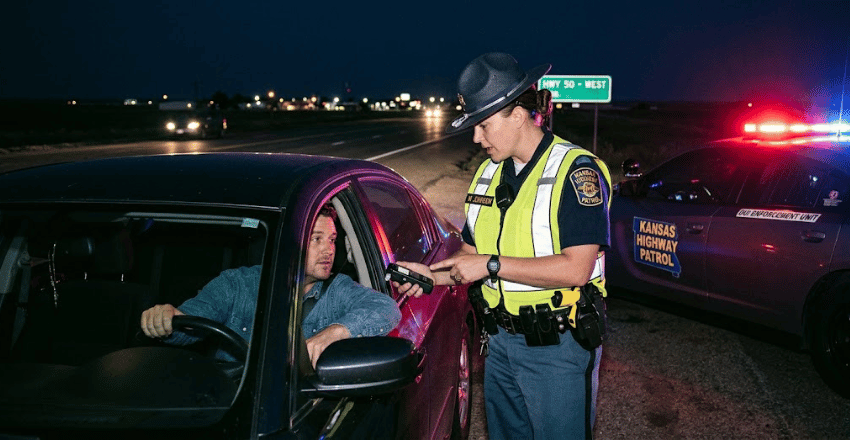
Kansas agencies have used saturation patrols, check lanes, and increased holiday enforcement during 2026. Dodge City, for example, announced increased DUI activity during several summer periods. The Kansas Highway Patrol also added enforcement during Labor Day through the national Drive Sober or Get Pulled Over campaign.
The numbers show that officers are actively making impaired-driving arrests. KHP reported 27 DUI arrests during its Independence Day holiday reporting period. That was higher than the 25 arrests reported during the comparable period in 2025.
Labor Day enforcement produced 23 DUI arrests in 2026. That figure was slightly above the 22 reported in 2025. No DUI-related fatal crash occurred during the 2026 Labor Day reporting period.
Enforcement campaigns matter because more patrol activity can increase the chance that a traffic stop becomes a DUI investigation. Officers may look for driving behavior, physical observations, field sobriety performance, and evidence from chemical tests. LawFLOA’s sobriety test guide explains how roadside testing differs from breath, blood, and other chemical testing. LawFLOA sobriety test guide
Kansas DUI Crackdown Fines Jail Penalties by Offense
Kansas penalties increase significantly as prior offenses accumulate. The sentence also depends on whether a third offense qualifies as a misdemeanor or felony. Drivers should not assume that every third DUI carries the same classification.
First DUI Conviction
A first conviction is a class B nonperson misdemeanor. Kansas law allows a sentence of 48 consecutive hours to six months in prison. A court may instead order 100 hours of public service.
The statutory fine ranges from $750 to $1,000. Other expenses may include legal representation, evaluations, treatment, insurance changes, and license requirements. These costs are separate from the criminal fine.
A first case should not be treated as a minor traffic ticket. DUI is specifically excluded from ordinary municipal traffic fine schedules. A conviction can therefore affect both a person’s criminal record and driving privileges.
Second DUI Conviction
A second conviction is a class A nonperson misdemeanor. The statutory sentence runs from 90 days to one year of imprisonment. The required fine ranges from $1,250 to $1,750.
Probation does not necessarily eliminate confinement. Kansas law requires at least 120 hours of confinement as a probation condition for a second conviction. At least 48 hours of that period must be spent in prison.
The remaining qualifying confinement can include approved work release or house arrest. Specific credit rules apply to those alternatives. A defendant should review the actual sentencing order rather than assuming home confinement equals jail time.
Third DUI Conviction
A third conviction requires closer attention to the driver’s history. In some circumstances, it can remain a class A nonperson misdemeanor. It can become a severity-level 6 nonperson felony when a qualifying prior conviction occurred within the preceding 10 years.
For a misdemeanor third conviction, Kansas law provides 90 days to one year of imprisonment. The statutory fine ranges from $1,750 to $2,500. A person receiving probation must still serve at least 30 days of qualifying confinement.
A felony third conviction is different. The current DUI statute does not impose the same mandatory fine stated for the misdemeanor third offense. A court may still have authority to impose a felony fine under separate Kansas sentencing statutes.
That distinction became especially clear in a 2026 Kansas Court of Appeals decision. The court vacated a $1,750 fine that had been imposed under an older version of the law. The decision confirms why current statutory language matters when evaluating a repeat case.
Fourth or Subsequent DUI
Under current Kansas law, a fourth or later conviction is a severity-level 6 nonperson felony. If granted, probation includes at least 30 days of confinement. At least 48 consecutive hours must first be served as imprisonment.
The remaining qualifying period may involve approved work release or house arrest. Kansas law also provides substance-use assessment and supervision requirements in felony cases. The actual sentence can depend on criminal history and Kansas sentencing rules.
Anyone facing a repeat case may benefit from understanding how defense counsel evaluates evidence and sentencing exposure. LawFLOA’s DUI attorney guide covers evidence review, defense issues, negotiations, and court representation. LawFLOA DUI attorney guide
A DUI Can Trigger Separate Driver’s License Penalties
The criminal case is only one part of a Kansas DUI problem. The Kansas Division of Vehicles can impose administrative suspension and ignition-interlock restrictions. These consequences can arise from test failure, test refusal, or an alcohol-related conviction.
For a standard first test failure or qualifying conviction, Kansas generally provides a 30-day suspension. Additional driving restrictions can follow that suspension. A BAC of 0.15% or higher produces tougher administrative consequences.
At 0.15% or higher, a first occurrence generally brings a one-year suspension. It is followed by a one-year ignition-interlock restriction. Repeat occurrences can produce longer interlock periods.
A chemical-test refusal carries different penalties. A first refusal generally results in a one-year suspension, followed by two years of ignition-interlock-only driving. Later refusals increase the restricted-driving period.
What Happens If You Refuse Chemical Testing?
Kansas law allows officers to request qualifying breath, blood, urine, or other testing under statutory conditions. The exact procedures depend on the test type. Refusal can create significant driver’s license consequences even before the criminal charge is resolved.
For breath or other non-blood testing, Kansas requires officers to provide specified notices. Those notices include the potential one-year suspension for refusing. The driver’s refusal can also be admitted as evidence in proceedings arising from the incident.
Do not confuse refusal with roadside field sobriety exercises. Different procedures and legal rules apply to each testing category. Understanding that distinction can prevent misleading assumptions about what happened during a stop.
Do Prior DUIs From Other States Count?
A prior offense from outside Kansas can matter. Kansas courts have addressed when comparable convictions from another jurisdiction count toward repeat-offender classification. That issue can significantly change the criminal exposure in a later case.
The Kansas Supreme Court has previously held that qualifying Missouri DWI convictions can count as prior offenses. The statutory analysis can depend on the governing version of Kansas law. Therefore, records from older cases deserve careful review.
Diversion agreements may also count for certain alcohol-related administrative purposes. Kansas statutes expressly include some diversion agreements within the definition of an alcohol-related conviction. A person should not assume a diversion disappeared for every future legal purpose.
What Should You Do After a Kansas DUI Arrest?
Start by identifying every proceeding connected with the arrest. A criminal court case and an administrative license matter can move on different tracks. Deadlines can therefore matter before the criminal case reaches trial.
Keep all paperwork provided by police, the court, and the Division of Vehicles. Record the date, location, testing process, and any requested chemical test while events remain fresh. Do not alter or discard documents because they may later explain important procedural details.
Consider speaking with a Kansas-licensed defense attorney about the specific charge. Counsel can examine the stop, testing procedures, criminal history, and possible administrative consequences. LawFLOA’s broader criminal-law resources can also explain common stages after an arrest.
Court appearances must also be taken seriously. Missing a required hearing can create a separate problem and may lead to a warrant. LawFLOA’s bench warrant guide explains how failure-to-appear issues can affect an existing criminal case. LawFLOA bench warrant guide
Why the Fine Is Only Part of the Financial Impact
The statutory criminal fine is not always the largest expense connected with a DUI. A person may also face court costs, legal fees, treatment expenses, and ignition-interlock charges. Insurance costs may change after a conviction or license action.
Employment can also be affected when driving is part of the job. Commercial drivers face especially strict rules because the alcohol threshold is lower. A commercial license can be disqualified after qualifying DUI conduct or testing violations.
These indirect consequences make penalty tables useful but incomplete. The real financial impact depends on the driver’s record, license type, insurance, employment, and sentence. Two people with the same criminal fine can face different total costs.
Frequently Asked Questions
What are the Kansas DUI crackdown fines and jail consequences for a first offense?
A first Kansas conviction is a class B nonperson misdemeanor. The fine is $750 to $1,000. The sentence can range from 48 consecutive hours to six months, or 100 public-service hours at the court’s discretion.
License penalties can apply separately from the criminal sentence. A standard first test failure can trigger a 30-day suspension and later restrictions. A BAC of 0.15% or higher creates a longer initial suspension.
Is a third DUI automatically a felony in Kansas?
No, a third DUI is not automatically a felony in every case. Kansas law distinguishes between certain misdemeanor and felony third convictions. A qualifying prior conviction within the preceding 10 years can make the third offense a severity-level 6 nonperson felony.
That classification can materially change sentencing exposure. The dates and legal status of prior cases therefore matter. Old assumptions about Kansas DUI law should not replace a review of the current statute.
Can Kansas suspend my license if I refuse a breath test?
Yes, refusing a breath test can trigger an administrative driver’s license suspension. A first refusal generally results in a one-year suspension. This is followed by a two-year ignition-interlock restriction.
Refusal evidence may also be used in proceedings related to the alleged impaired driving. Different rules can apply depending on the requested test. Drivers should review the notice provided at the time of arrest.
What BAC is illegal in Kansas?
For most adult drivers, Kansas uses 0.08% as the statutory alcohol-concentration threshold. A person can still face DUI allegations based on impairment evidence without a qualifying 0.08% test. Drug impairment also falls within the state’s DUI law.
Drivers under 21 face a 0.02% threshold. Commercial vehicle operators must maintain a 0.04% BAC while operating a commercial vehicle. These lower limits can lead to serious license consequences.
Does a first Kansas DUI always require jail?
Not necessarily. Kansas law provides 48 consecutive hours to six months of imprisonment for a first conviction. The statute also allows a court to order 100 hours of public service instead.
Later convictions provide much less flexibility. Mandatory confinement conditions apply to repeat-offense probation. That difference is one reason prior DUI history matters so much.
The Bottom Line
Kansas continues to use focused impaired-driving enforcement, including holiday patrols and sobriety operations. The penalties can include criminal fines, confinement, license suspension, and years of ignition-interlock restrictions. Repeat cases can eventually become felony offenses.
Anyone charged should verify the current statute and the exact history attributed to them. A prior conviction, diversion, refusal, or high BAC can change the consequences. Get legal advice from a Kansas-licensed attorney who can review the facts and current law.