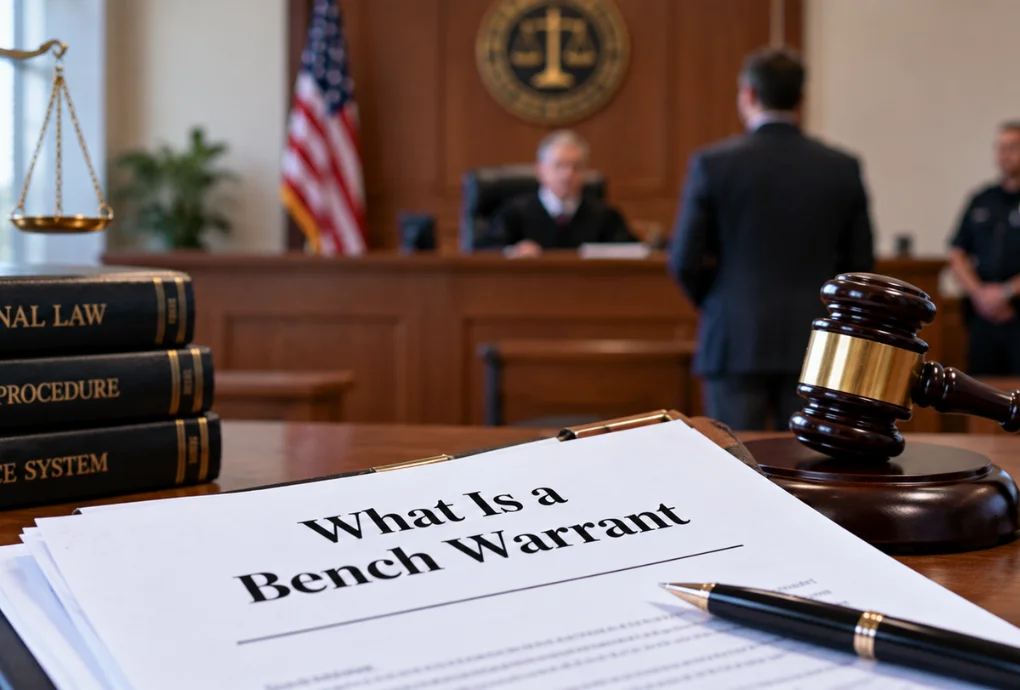
What is a bench warrant? In the United States, it is a court order, typically issued by a judge, that authorizes law enforcement to arrest or detain someone and bring that person before the court. It commonly follows a missed court date, a violated court order, contempt, or another failure to comply with court requirements.
Receiving or discovering an outstanding court warrant can be stressful, but the term does not automatically mean you are accused of committing a new crime. Judges often use this type of order to require someone to return to court after missing an appearance or another legal obligation. The exact procedure, arrest risk, bond rules, and how to clear the order depend on the state and the court handling the case.
| What Is a Bench Warrant | General U.S. answer |
|---|---|
| Who issues it? | A judge or court |
| Why is it issued? | Often for failing to appear or failing to comply with a court order |
| Can it lead to arrest? | Yes, law enforcement may take the named person into custody. |
| Is it the same as a standard arrest warrant? | No, although both can authorize an arrest. |
| Can it affect bail? | Yes, depending on the case and local rules |
| Does it disappear automatically? | Often no; it may remain active until served, recalled, quashed, or otherwise resolved. |
| Are the rules identical nationwide? | No, procedures vary by jurisdiction |
Key Takeaways
- A judge commonly issues the warrant after someone misses court or violates an existing court requirement.
- Police may discover an active warrant during a traffic stop or other law enforcement contact.
- Ignoring the problem can create additional legal and practical consequences.
- The safest response is usually to verify the case through the issuing court and learn the local procedure before taking action.
- Never send money or sensitive information to an unexpected caller who claims payment will immediately cancel a warrant.
What Is a Bench Warrant, and Why Is It Issued?
A court issues this type of warrant from its own authority, which explains the word “bench,” a traditional reference to the judge’s position in the courtroom. Cornell Law School’s Legal Information Institute describes it as a court-issued process for detaining or arresting a person in a criminal or civil proceeding. New Jersey Courts gives a narrower, everyday definition: an order that permits arrest after a failure to appear or comply with a court order.
The key point is that the order usually concerns an existing relationship with a court rather than beginning with a new police investigation. Maryland’s court glossary, for example, states that a bench warrant is a warrant a judge issues to arrest a defendant for failing to appear in court as required. Rules and terminology still differ among states, so the docket and warrant issued in the specific case control what happens next.
Common Reasons a Judge May Issue One
Missing a scheduled hearing is one of the most familiar triggers, but it is not the only one. Courts can use arrest orders to enforce several kinds of legal obligations, depending on state statutes and court rules. The reason should appear in the case record or in information available from the issuing court.
Common situations may include:
- Failing to appear for a required criminal court hearing.
- Ignoring a summons, subpoena, or other mandatory appearance.
- Violating probation or another court-ordered condition.
- Failing to comply with an order involving fines, restitution, or another obligation where local law permits a warrant.
- Failing to appear in certain traffic or misdemeanor proceedings.
Traffic cases provide a useful example because the consequences vary widely. Some courts may issue a warrant after a missed traffic appearance, while the available remedies depend on the jurisdiction and type of citation. Readers dealing with a citation can also review LawFlowA’s speeding ticket lawyer guide, while people facing supervision issues may find the parole versus probation guide helpful for understanding those separate legal concepts.
What Happens After a Bench Warrant Is Issued?
Once a bench warrant is active, law enforcement may be authorized to arrest the person named in it and bring that person before the court. An officer may discover the warrant during a traffic stop, an unrelated investigation, or another encounter in which they check identifying information. Whether officers actively search for the person and how quickly an arrested person sees a judge depends on local law and agency practice.
The court may also reconsider release conditions after a missed appearance, especially if the underlying case already involved bail or pretrial release. In some jurisdictions, a failure to appear can produce consequences separate from the original charge, such as bail forfeiture or an additional failure-to-appear allegation. A California superior court, for example, lists a possible additional failure-to-appear complaint among the consequences that can follow a missed criminal hearing.
Bench Warrant vs. Arrest Warrant
A bench warrant and a standard arrest warrant can both authorize law enforcement to take someone into custody, but they usually arise for different reasons. The first commonly follows a missed appearance or violation of an existing court requirement, while a standard arrest warrant often begins with allegations that a person committed a crime. Terminology is not perfectly uniform, and some jurisdictions formally classify the court-issued order as a type of arrest warrant.
| Issue | Bench warrant | Standard arrest warrant |
|---|---|---|
| Typical starting point | Existing court case or court obligation | Suspected criminal conduct |
| Common trigger | Missed hearing or noncompliance | Probable-cause showing related to an alleged offense |
| Issued by | Judge or court | Judge or magistrate after the required legal showing |
| Main purpose | Bring the person before the court. | Authorize arrest in connection with alleged criminal conduct. |
| Can lead to custody? | Yes. | Yes. |
This distinction matters because clearing one type of warrant may require a different procedure from responding to a newly issued criminal arrest warrant. A lawyer may need to determine why the order was entered, what the docket says, and whether the court has set bond or special surrender conditions. LawFlowA’s criminal justice lawyer guide explains the broader stages that can follow an arrest, including first appearance, arraignment, bail, and pretrial proceedings.
Do Bench Warrants Expire?
People sometimes assume an old warrant disappears after enough time passes, but that assumption can be costly. Many remain open until the court recalls, quashes, closes, or executes them, although the exact rule depends on the issuing jurisdiction. For example, 2026 local federal rules in the District of Wyoming state that certain warrants for petty or misdemeanor failures to appear remain open until the court orders them closed.
Age alone, therefore, should not be treated as proof that an old court problem is gone. Court records may also contain information that affects the status of the case, including later orders or recalls. If you are unsure, verify the status through the court that issued the order rather than relying on memory or an unofficial database.
How to Deal With an Outstanding Warrant Safely
If you learn a bench warrant may exist, ignoring it usually leaves the possibility of an unexpected arrest unresolved. The practical goal is to confirm what the court actually ordered and identify the procedure the issuing jurisdiction provides. Avoid guessing about bond, surrender, or whether an attorney can appear for you because those details can change from one court to another.
- Verify the warrant with the issuing court. Use the court’s official website, clerk’s office, or other verified government channel to confirm the case number and current status.
- Find out why it was issued. Determine whether the issue involves a missed hearing, probation, a citation, a subpoena, unpaid obligations, or another court order.
- Check the local procedure before appearing. Ask what the court requires for surrender, scheduling, bond, or a request to recall or quash the order.
- Consider speaking with a licensed attorney in that jurisdiction. Counsel can review the docket and explain whether a motion or arranged appearance is available.
- Gather documents that explain the missed obligation. Medical records, proof of incarceration, notices, travel records, or other evidence may matter if they relate to why you missed the appearance.
- Follow the new court instructions carefully. Missing another required date can make the situation harder to resolve.
Do not assume that calling the clerk automatically cancels the warrant, because clerks generally cannot provide legal advice or override a judge’s order. At the same time, contacting the correct court can help you learn the procedural options available in that county. If the underlying matter is criminal, LawFlowA’s Criminal Law section provides additional background on criminal cases and related legal issues.
Can a Bench Warrant Be Cleared Without Going to Jail?

A bench warrant does not produce the same result in every courthouse, so there is no reliable nationwide yes-or-no answer. Solano County Superior Court in California states that some eligible misdemeanor defendants who missed court may be given a new date after contacting the criminal clerk. Sutter County Superior Court, by contrast, instructs people with an issued warrant to surrender to law enforcement.
Those examples show why advice from another county or state may not fit your case. An attorney may sometimes ask the judge to recall or quash a warrant, arrange a voluntary appearance, or address bond before a person is unexpectedly arrested.
Whether any of those choices exist depends on the charge, history of appearances, warrant language, and local rules. The issuing court’s official procedure should guide the next step.
Watch for Fake Warrant and Court-Payment Scams
Scammers sometimes use the fear of arrest to pressure people into making immediate payments or sharing financial information. Federal courts continue to warn about calls, texts, and emails claiming that a warrant can be removed by paying gift cards, credit cards, cryptocurrency, or another urgent fee.
The U.S. District Court for the District of Oregon currently warns the public about phishing calls, texts, and emails that threaten prosecution for failing to appear and pressure people into paying by gift card or credit card. If someone unexpectedly tells you that you must pay immediately to avoid arrest, do not rely on the phone number or link they provide.
Look up the court independently through its official government website and contact the clerk using verified information. Do not disclose Social Security numbers, bank details, card information, or payment credentials to an unsolicited caller claiming to clear a warrant.
What to Do Next
If you think an active warrant may exist, verify the case through the issuing court before making assumptions about what the judge requires. Because state and local procedures differ, consider speaking with a criminal-defense attorney licensed where the case is pending before surrendering, traveling to court, or making decisions about bond. Addressing the court issue through verified channels is safer than waiting for an unexpected law-enforcement encounter.
Frequently Asked Questions
What is a bench warrant for failure to appear?
A bench warrant for failure to appear is an order a judge may issue when a person does not attend a court proceeding when attendance was required. The warrant can authorize law enforcement to arrest that person and return them to court. Whether a judge must first make particular findings about notice or the reason for the absence depends on the jurisdiction.
Can police arrest you on a bench warrant?
Yes, an active court-issued warrant can authorize law enforcement to take the named person into custody. An officer may discover it during a traffic stop or another official contact rather than through a planned search. The warrant and applicable local procedures control what happens after the arrest, including release or detention.
How long does a bench warrant last?
Many court warrants remain active until a judge serves, recalls, quashes, or closes them, rather than disappearing after a fixed period. The exact duration and legal effect depend on the issuing jurisdiction and case. An old warrant should therefore be confirmed directly with the responsible court rather than assumed inactive.
Can a bench warrant be cleared without going to jail?
Sometimes a court may provide a procedure to schedule an appearance, request recall, or address the matter through counsel, but this is not guaranteed. Other courts may require surrender once they issue the order. The correct approach depends on the issuing court, the underlying charge, and the terms of the warrant.
Is a court-issued warrant the same as being convicted of a crime?
No, a warrant does not, by itself, prove that a person is guilty of the underlying criminal accusation. It is an order authorizing custody or requiring the person to appear in court. Some jurisdictions may have separate charges or penalties for failing to appear, but those issues require their own legal process.