Hiring a boat accident lawyer comes down to one blunt fact: the clock on a water injury claim runs faster than most people expect. Some deadlines are counted in hours. Fees, in most cases, cost nothing upfront. What follows is the pricing, the liability rules, and the timing traps that law firm websites tend to leave out. Elsewhere on the site: Rule 36.
Short version. Most maritime injury attorneys work on contingency, taking roughly 33% to 40% of whatever they recover after a free first meeting and with no fee if you lose. You usually get three years to sue under federal maritime law. A vessel owner, though, can move to cap your payout within six months of hearing from you.
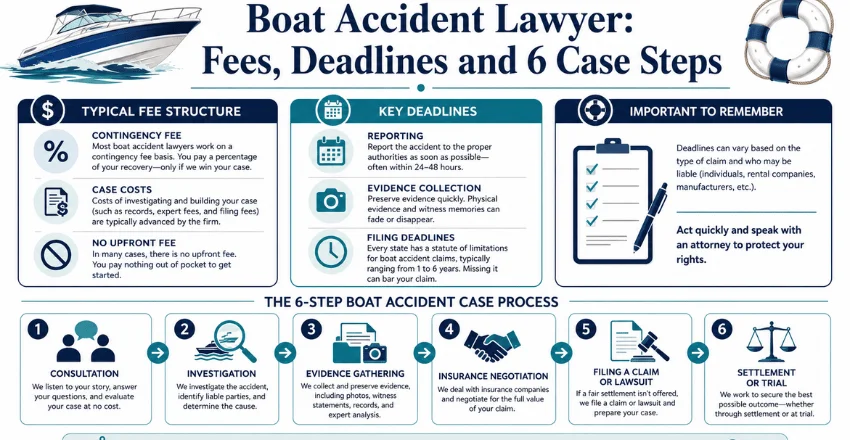
Boating injury claims at a glance
| The question | The short answer |
| Who pays | The at-fault operator, the vessel owner, a rental or charter company, a marina, or a parts maker |
| Deadline to sue | Three years under federal maritime law, sometimes shorter under state law |
| Deadline to report | 48 hours after a death or serious injury, 10 days for damage of $2,000 or more |
| Typical fee | 33% to 40% of the recovery, charged only if you win |
| Upfront cost | Usually $0, including the first consultation |
| The trap nobody mentions | The owner can file to limit liability within six months of your written claim |
| What drives value | Medical bills, lost income, permanent injury, and the insurance limits that exist |
Key takeaways
- Report the crash to the state boating authority fast. Waiting weakens the record everyone else will rely on.
- Contingency fees run about a third of the recovery, so the consultation costs you nothing.
- Water law is not car law. Federal rules can override the state statute you assumed applied.
- A six-month limitation on filing by the owner is the single most common way a strong claim shrinks.
- Crew members sue under the Jones Act. Guests and passengers do not.
Do you need a boat accident lawyer, or can you settle alone?

If the only damage is a scratched hull and a bruised ego, deal with the insurer yourself. Once someone needs a hospital, the math changes. Adjusters price early offers against your worst week, not your recovery, and a signed release ends the claim for good.
Water cases are also not a rare corner of injury law. According to the Coast Guard’s 2024 recreational boating statistics, published in July 2025, there were 3,887 recreational boating incidents that year, causing 556 deaths and 2,170 nonfatal injuries. Property damage came to roughly $88 million.
Call a lawyer when any of these apply:
- Someone was hospitalized, drowned, or is still missing.
- Fault is disputed, or two vessels blame each other.
- A rental firm, charter operator, or tour company owned the boat.
- The insurer has denied the claim or gone quiet for weeks.
- You were working aboard when it happened.
Handling it yourself is defensible when injuries are minor, and liability is obvious. Screening questions here match what you would ask before picking any good injury lawyers for a road crash. Add one more: has this office ever tried a case on the water?
What a boating accident attorney costs:
Almost nobody pays a maritime injury lawyer by the hour. The standard arrangement is a contingency fee, so the firm carries the cost of the case and takes a percentage at the end.
| Stage of the case | Usual fee share |
| Settled before a lawsuit is filed | About 33% |
| Settled after filing, before trial | 35% to 40% |
| Tried the verdict or appealed | 40%, sometimes more |
Case costs sit separately from the fee. Expect expert marine surveyors, accident reconstruction, deposition transcripts, and court filing charges, often several thousand dollars in a contested claim. Ask, in writing, who absorbs those costs if the case loses. Good firms eat them. Others bill you.
The deadlines that quietly kill boat claims
This is where do-it-yourself claims fall apart, because the water has its own calendar.
- 48 hours. Federal reporting deadline after a death, a disappearance, or an injury needing more than first aid.
- 10 days. The reporting window for property damage alone, which starts at $2,000 in most places and lower in some states.
- Six months. The period in which a vessel owner may ask a federal court to cap liability at the value of the boat under 46 U.S.C. 30529.
- One year. The suit deadline is printed on most cruise and ferry tickets, with written notice often due far sooner.
- Three years. The general maritime limit for personal injury and death claims, set by 46 U.S.C. 30106.
Those first two are federal rules, published as 33 CFR 173.55 and enforced through the states. A missed report will not end your claim on its own. It does hand the defense a story about a victim who said nothing for a month, and juries notice that.
The six-month limitation action deserves its own warning. An owner who receives your written demand can start a proceeding that pools every claim against the vessel’s post-accident value, which for a sunken runabout might be almost nothing.
Who is liable in a boating accident
Rarely just one person. Water claims spread liability across several parties at once: owners, operators, rental firms, and builders.
- An inattentive operator, speeding, drinking, or watching the wrong quarter of the water.
- The owner who lent the helm to someone unqualified or skipped maintenance.
- A rental or charter company that handed over keys with no safety briefing and no check of experience.
- Marinas and fuel docks whose slip, ramp, or pump created the hazard.
- Manufacturers of a failed steering cable, throttle, or propeller guard.
That last route is a separate body of law. Where a defect caused the crash, product liability attorneys can pursue the builder alongside the operator’s insurer, which matters enormously when the operator carries a thin policy.
Maritime law, state law, or the Jones Act?
Three regimes can apply, and the answer decides your deadline and your damages. General maritime law covers most crashes on navigable waters, including big lakes and rivers used for commerce. State negligence law handles small private ponds and some inland incidents.
The Jones Act belongs to seamen: deckhands, fishing crew, tug, and dinner-cruise staff who spend real time aboard a vessel in navigation. Passengers and weekend guests are not seamen, so the Jones Act does nothing for them. Dock and shipyard workers fall under a third scheme closer to the workman’s compensation route, which pays without proof of fault but caps what you can collect.
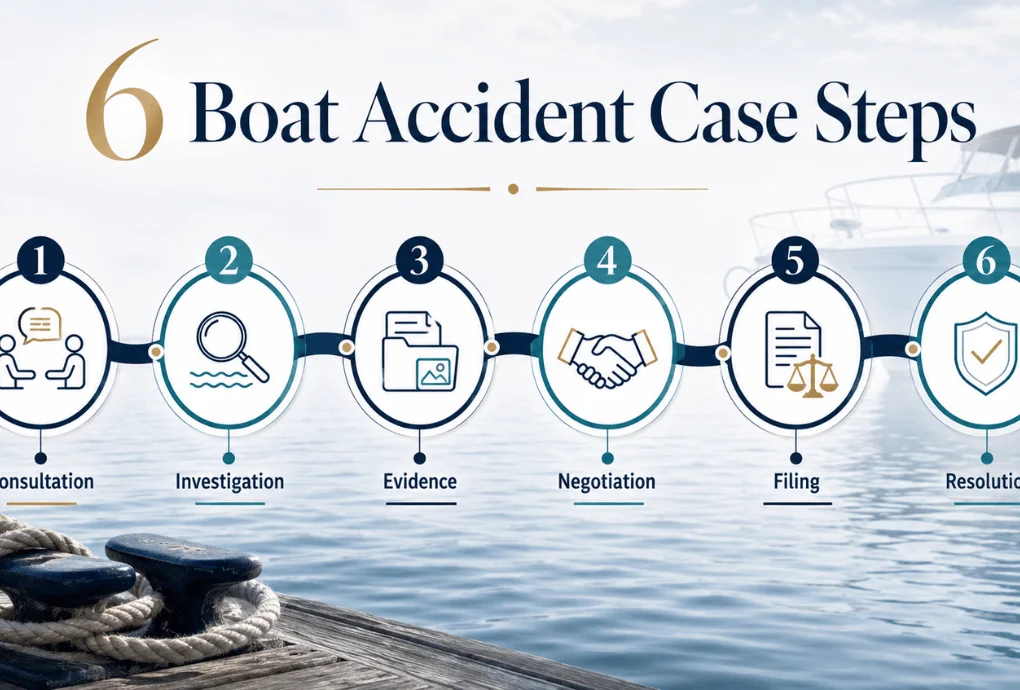
Six steps of a boat injury claim
- Get treated and report. Emergency care first, then the state accident report within the federal window.
- Preserve the vessel and the data. Ask in writing that the boat, engine, and electronics stay untouched.
- Open the claim. Your lawyer notifies every insurer: the operator’s, the owner’s, the marina’s, and yours.
- Build the damages file. Medical records, wage statements, and a treating doctor’s view of what comes next.
- Demand and negotiate. A written demand starts real numbers moving and often the six-month limitation clock too.
- File suit if talks stall. Most cases still settle, but only after the complaint gives the deadline teeth.
Rhythm here mirrors a road claim. If you have been through one, this motorcycle accident case walkthrough covers the same negotiation stages in more detail.
What is your case worth?
Anyone quoting a figure before seeing your medical file is guessing. Value comes from five inputs, and the last one is brutal.
- Medical bills already paid, plus the treatment your doctor says is coming.
- Wages lost and earning power lost for good.
- Pain and scarring, plus the activities you cannot go back to.
- Fault split, since your share is usually subtracted.
- Available insurance, which on a private boat can be far thinner than on a car.
Recreational hull policies frequently carry modest liability limits. When the limit is $300,000, and the injuries are catastrophic, the real work becomes finding a second defendant with deeper coverage.
Evidence that disappears within days
Boats get repaired and repainted, then sold. Water erases the rest.
- Engine control module data and chartplotter tracks.
- Marine patrol and sheriff incident reports, plus any breath test result.
- Float plans, rental agreements, and safety briefing checklists.
- Marina and lock camera footage, usually overwritten in one to two weeks.
- Photographs of damage, weather logs, and passenger phone video.
How to pick the right attorney?
Marketing pages all sound the same. Five questions separate them quickly.
- How many boating or maritime cases have you resolved, and in what waters?
- Have you defended against a limitation of liability petition before?
- Who handles my file day-to-day, you or a case manager?
- What percentage applies at each stage, and who pays costs if we lose?
- What is your read on my deadline, today, in writing?
An office that hesitates on question two has probably never seen the filing that matters most.
What to do in the first 48 hours after a boating accident
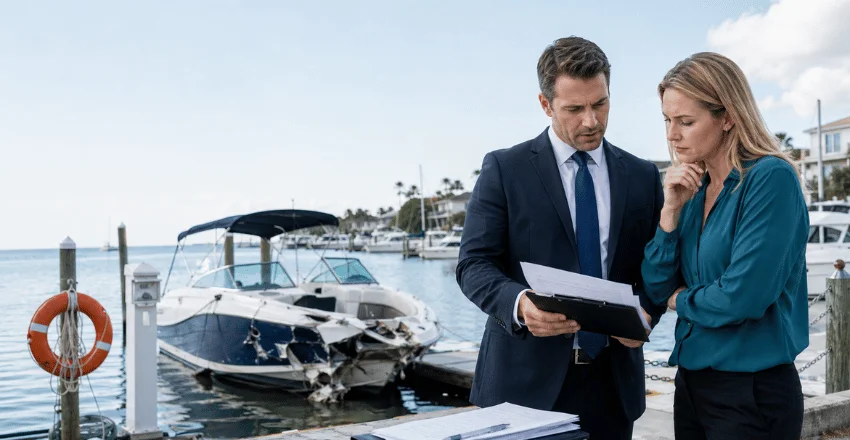
Treat the first two days as evidence gathering, not paperwork. Get medical care and say yes to the ambulance. Photograph both vessels, the damage, and the water conditions before anything is towed. Collect names, phone numbers, and registration numbers from every person aboard. Then file the state report and stay off the phone with the other insurer.
Your next step
Get a free case review this week rather than next month. Bring the incident report, your medical paperwork, photographs, and any letter the insurer has sent. Most firms will tell you inside one call whether a claim exists. A boat accident lawyer who reads your deadline early is worth far more than one who reads it in six months.
Frequently Asked Questions
Typically 33% to 40% of the recovery, with nothing due upfront and no fee if the claim fails. Case costs are handled separately, so get that term in writing.
Three years under general maritime law for injury or death. State deadlines can be shorter, and a cruise or ferry ticket may cut it to one year.
Yes. Maritime law splits damages by share of blame rather than barring the claim, so a 30% share reduces the award by 30%.
No. It protects seamen who work aboard a vessel in navigation. Passengers and guests bring ordinary maritime negligence claims instead.
Look wider. The owner, the rental company, a marina, a manufacturer, or your own uninsured watercraft coverage may all be in play.